Good management means speaking to each talent in the language that brings out their best.
In a brigade, at reception or in housekeeping, personalities work side by side every day: the head waiter who takes charge during a rush, the governess everyone relies on, the night auditor who misses nothing.
Management is also one of the first levers of retention, as we saw in our article on turnover in hospitality and food service. The DISC method offers a simple reading grid for adapting how you communicate, motivate and delegate.
1. The DISC method in a few words
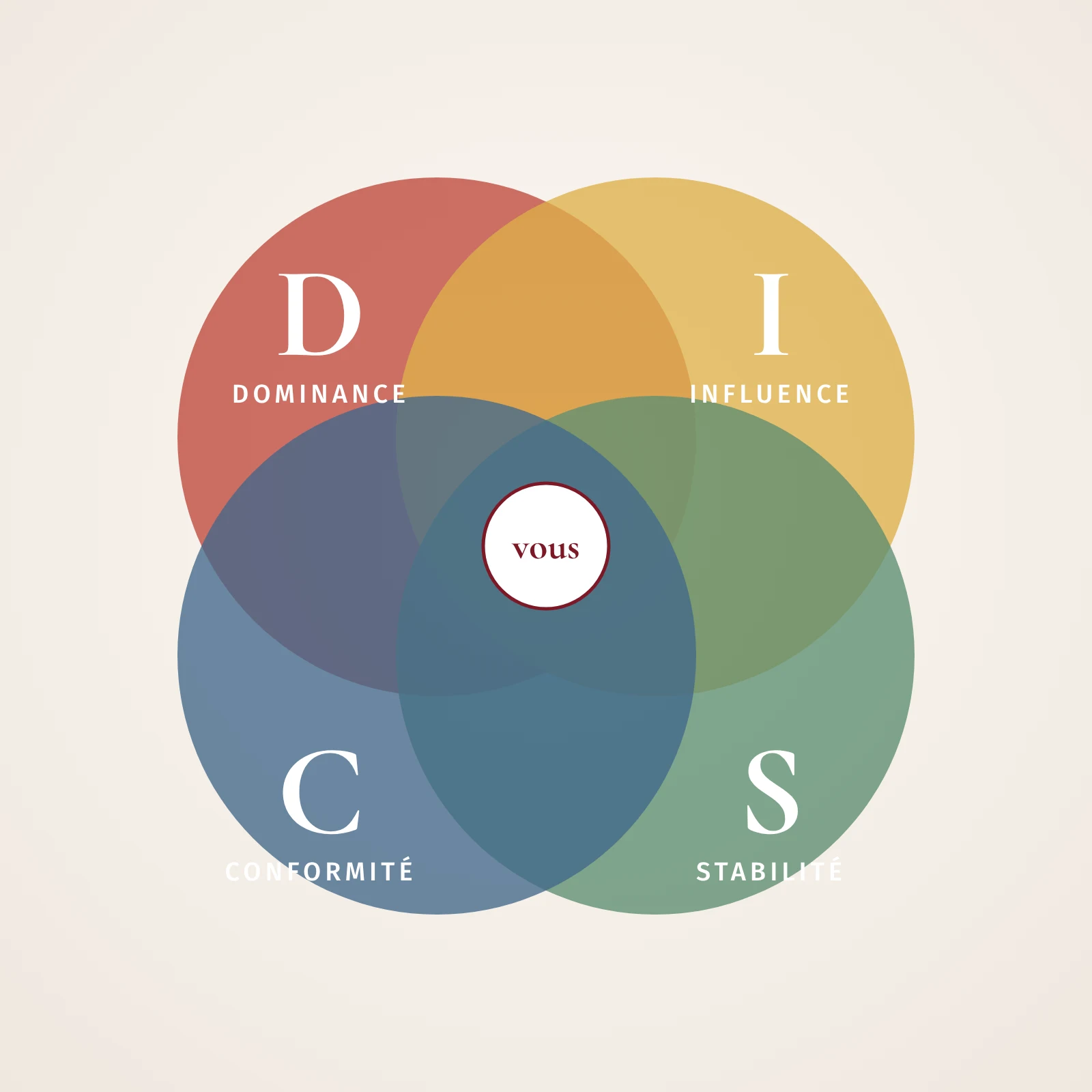
The DISC method is based on the work of American psychologist William Moulton Marston, published in the late 1920s. It describes four broad behavioural tendencies, often associated with four colours.
Likes to decide, take on challenges and move fast. In hospitality, this is often the chef de partie who takes charge in the middle of a rush.
Strengths: reactivity, leadership, results-driven.
Watch out: impatience, risk of being abrupt.
Creates connections, carries others along and brings energy. This is the receptionist or bartender who turns every guest into a regular.
Strengths: relationships, optimism, creativity.
Watch out: follow-up on details, organisation.
Attentive, loyal, committed to team harmony. This is the floor housekeeper the whole team can count on.
Strengths: patience, consistency, team spirit.
Watch out: sudden changes, difficulty saying no.
Committed to quality, procedures and facts. This is the sommelier or night auditor who leaves nothing to chance.
Strengths: rigour, quality, analytical mind.
Watch out: perfectionism, needs time to decide.
Good to know: every talent combines the four colours, usually with one or two dominant ones, and their behaviour can vary with context. The DISC method is a communication tool: it measures neither skills, nor intelligence, nor a person's worth.
2. Know yourself before managing others
Every manager has their own dominant colour, which naturally shapes the way they lead. Becoming aware of it helps you make the most of it — and avoid misunderstandings.
- A red manager decides fast and sets a clear course, but can jolt green profiles who need time.
- A yellow manager motivates and rallies, but can neglect follow-up and frustrate blue profiles seeking precision.
- A green manager builds trust, but can avoid difficult topics and let a situation fester.
- A blue manager guarantees quality, but can micromanage and stifle red profiles seeking autonomy.
3. Adapting your communication to each profile
The message stays the same; the way you deliver it changes.
| Profil | Ce qui motive | Pour communiquer | À éviter |
|---|---|---|---|
| ##INLINE13##Rouge | Les défis, les résultats, l'autonomie | Aller droit au but, avec des faits et des objectifs clairs | Les longs détours, le contrôle permanent |
| ##INLINE14##Jaune | La reconnaissance, le contact, l'ambiance | Un ton chaleureux, de la place pour les idées | L'isolement, les consignes froides |
| ##INLINE15##Vert | La stabilité, l'harmonie, le sentiment d'être utile | Prendre le temps, expliquer le pourquoi, rassurer | Les changements brusques, la pression |
| ##INLINE16##Bleu | La qualité, la précision, la logique | Des consignes détaillées, des standards écrits, du temps pour analyser | L'approximation, l'improvisation |
4. The four management styles
Colour tells you how to communicate; the level of autonomy tells you how far to guide. The situational leadership model, developed by Paul Hersey and Ken Blanchard, distinguishes four styles according to each employee's skill and motivation.
The same employee may call for a different style depending on the task: an experienced head waiter in the dining room may need close guidance on stock management.
5. Delegating according to each profile
Delegating well frees up the manager's time and grows talent. But it has to be done in a way suited to each colour.
Give them an objective and an expected result, let them choose the path, plan short checkpoints. Ideal missions: a rush to manage, launching a new offer, handling an incident.
Give them missions involving connection and visibility, then frame deadlines and follow-up in writing. Ideal missions: welcoming new recruits, leading a briefing, an event.
Delegate gradually, explain the purpose of the mission, stay available and celebrate every success. Ideal missions: mentoring, following up a team, passing on know-how.
Provide a precise framework, the standards and the quality criteria, and give them time to prepare. Ideal missions: a quality audit, an inventory, a written procedure.
The five reflexes of successful delegation
- The purpose of the mission, and what it brings to the team.
- The expected result and the deadline.
- The degree of autonomy: suggest, decide, or decide then inform.
- The resources: the time, access, training and materials needed.
- A follow-up point, whatever the profile.
6. The test: what is your dominant colour?
Twelve everyday situations for a hospitality manager. For each, choose the answer that sounds most like you — no wrong answers.
In summary
The DISC method does not put anyone in a box. It gives managers a reading grid to know themselves better, communicate better and delegate better.
Managers who speak to everyone in their own language build calmer teams, talents who progress — and guests who feel the difference.